Inside the High School Success Zone: How WVVA Is Changing the Game for Online Learning
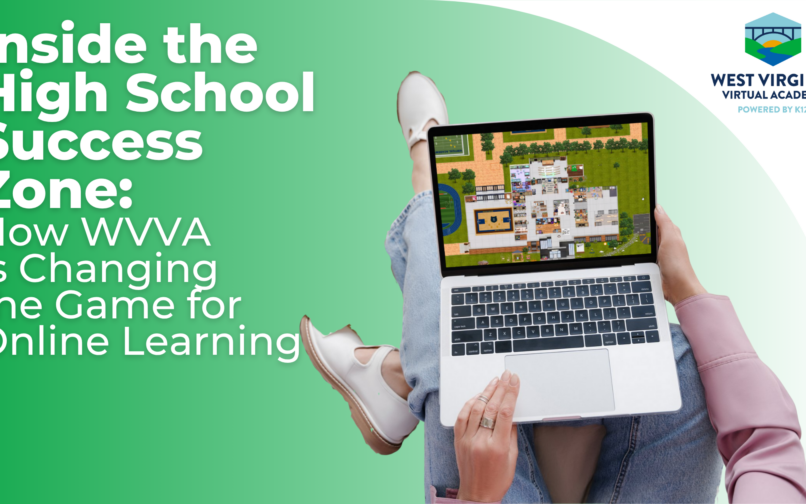
When students log into the High School Success Zone at West Virginia Virtual Academy (WVVA), an online high school in West Virginia, it’s not just another day in a virtual classroom — it’s a walk through a living, breathing digital campus that’s redefining what online education can be.
The Success Zone exists in the K12 Zone, an interactive virtual campus that turns online school into an open-world experience. In this zone, students can hang out with classmates, participate in activities and clubs, and access learning resources in a safe, welcoming environment.
A Virtual World Built for Real-World Success
In WVVA’s Success Zone, students thrive through online learning and succeed academically, socially, and personally within an interactive, game-like environment. Students can “walk” through virtual hallways, visit an administrative office, or discover all kinds of interactive resources.
“In cyberspace, we are able to generate these spaces that are a two-dimensional representation of a school,” WVVA Career Readiness Coordinator Jeremy Greene explained. “When kids walk up to the aquarium, they’ll get a live stream video so they can watch the Monterey Bay Aquarium. We can even gather students into our auditorium, do presentations and speak to them as a group.”
Beyond fun, this virtual world has a purpose. Greene emphasized how every element is designed to bring connection and context to learning, while recreating the environment of a stereotypical education.
Resources and Student Success
The Success Zone grew from a need Greene and his colleagues saw among WVVA’s students.
“One of the reasons I jumped into this is because in my role as a career-readiness coordinator, I’m getting questions constantly from students like, ‘What are my options if I want to do XYZ? I want to go to college internationally, so how can I get information about that? I want to pursue a welding certificate — do I have to go to college for that?’” Greene said.
To make those answers accessible, there are three specialized libraries inside the virtual world — a Military Library, a College Library, and a Career Library — each packed with interactive resources, simulations, and AI tools to guide students.
“The college library has information about the West Virginia Invests program, completing applications, and a digital agent that helps students identify which colleges would be good for them to explore,” he said. “If a kid wants to major in animal veterinary sciences, for example, they can ask the Campus Compass tool which colleges in West Virginia offer it.”
In the Success Zone, academic advising meets immersive play. Students can meet with counselors and teachers in virtual offices, walk into interactive exhibits, and explore potential futures.
“I teach the work-based learning course,” Greene said. “So, if kids need to have a conversation about the process, they can pop into the office space, walk up to me, and hear me speaking. They can also interact with one another as long as there’s an adult in the K12 Zone space.”
Students can even visit a digital “recruiter” in the Military Library or talk to a digital “career coach” in the trades section.
“Hello, and thank you for stopping at the trades,” one in-zone guide said. “From carpentry and plumbing to electrical work and welding, they offer a variety of careers that are fulfilling and in high demand.”
It’s an innovative way to help students explore opportunities they might not otherwise have access to, especially in rural parts of West Virginia.
“The Success Zone opens opportunities for children throughout West Virginia who may not have access to these resources otherwise,” Greene said. “Students can interact with all of it in one space.”
Connection and Community
For all its innovation, Greene says what makes the Success Zone most powerful is the sense of community it creates.
“At the beginning of the school year, we did an activity in the K12 Zone with all of our students — literally 1,100 high school students,” he recalled. “We had all these avatars in this space. It was wild. Kids were interacting with one another, doing scavenger hunts, finding teachers, and completing learning activities together. It was really cool.”
A Glimpse Into the Future
Greene sees WVVA’s Success Zone as a glimpse into the next era of online education — where learning platforms feel less like websites and more like worlds.
“The vision of this — and ultimately what it’s going to become — is this is what we’re going to be existing in,” he says. “Instead of kids logging into an LMS, they’re going to log into the K12 Zone, walking around a school building and going to class in that building. It’s the gamification of virtual teaching and learning.”
And as technology continues to evolve, so will the Success Zone. “We exist in an AI world, with technology amplifying itself so fast that in six months, this world won’t look the same,” Greene says. “The space wasn’t created for what it’s becoming — we just didn’t foresee it being used this way. Now, we’ve got it — we just have to shift and change the way we do things to get the results that students and teachers want.”
“It’s a growth process,” Greene says. “There are challenges with getting kids into the space because it’s something new and they don’t understand it fully yet. But those positive things keep coming out, and we respond to what kids are doing in the space.”
In a world where virtual learning can feel isolating, WVVA’s High School Success Zone is giving students something invaluable — connection, context, and a sense of belonging.
“I think it gives them a lot of context to what they’re doing,” Greene reflects. “It helps recreate the experiences that stick with students — the ones that make learning memorable.”
Learn more about WVVA and the Success Zone.
Back to BlogRelated Blog Posts

WVVA Student to Receive Prestigious Golden Horseshoe Award
CHARLESTON, W.Va. (Tues., June 4, 2024) – West Virginia Virtual Academy (WVVA) eighth grader Leah Mello […]
WVVA Honored as Purple Star School by West Virginia...
The West Virginia Virtual Academy (WVVA) proudly announces its designation as a Purple Star School by […]

Cheryl Stahle Makes History as First West Virginian to Win...
The West Virginia Virtual Academy (WVVA) proudly announces Cheryl Stahle, MEd, as a 2024 Changemaker Award […]